
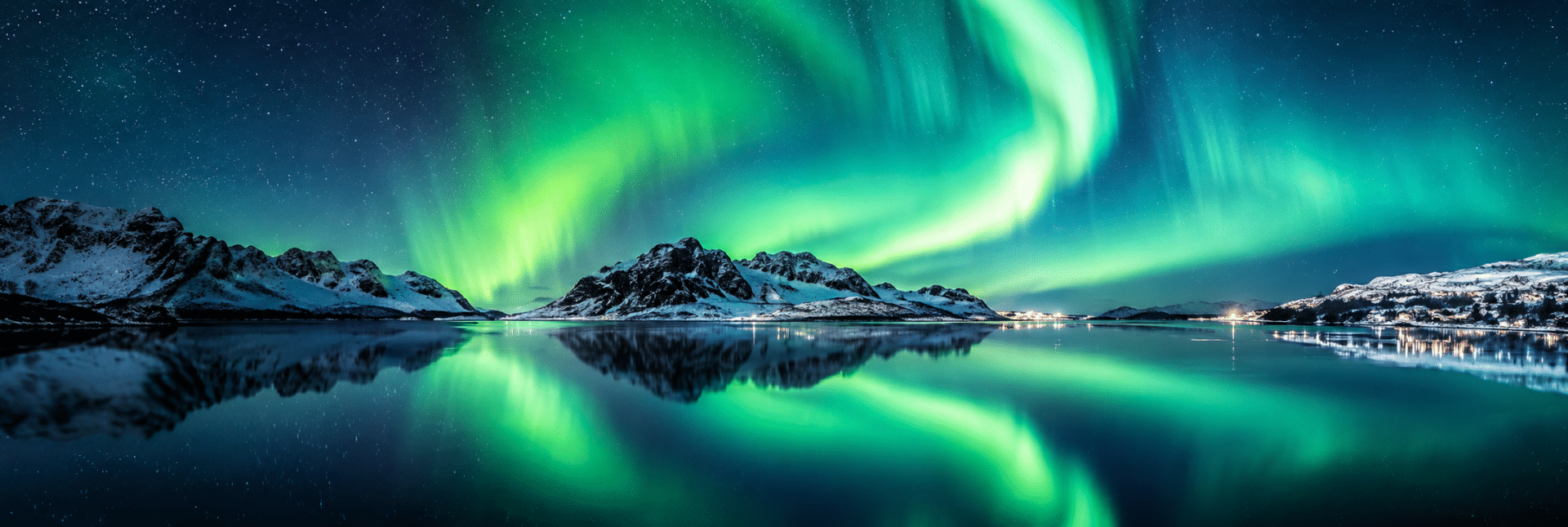
Here’s everything you need to know about seeing the Northern Lights if you’re dreaming about witnessing the magical dance of the Aurora Borealis. From the best destinations and times of year to expert tips for making the most of this bucket-list experience.
What are the Northern Lights?
The Northern Lights, otherwise known as the Aurora Borealis, is a spectacular light show. In a clear night sky, you will see the twirling and swirling of greenish-blue, sometimes pink, sometimes purple rivers of light that seem to flow erratically across the heavens. They move and dance unpredictably and are sometimes hardly noticeable for a while, and then suddenly, they are visible, glowing dazzlingly to the wonderment of all who see them.
The Northern Lights are a phenomenon that results when solar flares, sunspots, or solar storms send charged particles into the Earth’s atmosphere. These particles are drawn through space to the Earth’s two magnetic poles.
Here they crash into molecules of either oxygen or nitrogen, or both, to generate the swirling, flickering, glowing kaleidoscope-like effect of the Aurora Borealis. In the most straightforward scientific explanations, the Northern Lights interact with the solar wind, the Earth’s atmosphere, and the magnetic field.
Interestingly, in the far south of our planet, a similar phenomenon is observed, known as the Southern Lights or the Aurora Australis. However, this aurora is rarely seen – the area is sparsely inhabited compared to the polar region to the north.
When can I see the Northern Lights?
While the Northern Lights are present for much of the year, there aren’t enough hours of darkness to see them during the summer, even above the Arctic Circle. The winter season in the Arctic lasts from late September to late March / early April. During this time, the Arctic sky is dark enough for the Northern Lights to be visible in the right conditions. The aurora is most active around the Equinoxes in March and September.
Why can you only see the Northern Lights in specific regions?
The main issue preventing visibility is light pollution. Excess light pollution makes auroras more challenging to see and can break them up entirely.
This is because the artificial light from cities causes all atmospheric light—whether from stars, planets, the moon, or the Northern Lights—to scatter. Since Aurora is dependent on solar activity, a full moon does not affect the colour of the Northern Lights.
What colour is most common to see in the Northern Lights?
The shortest and most scientifically correct answer would be that most auroras are green. It doesn’t always appear green to the naked eye, though. Sometimes it seems silver, or even an unusual hue of grey or white; however, when you point a camera at it, you will usually see green pop out from the sky.
When cruising to view the Aurora Borealis, there are a few essential things to remember. To give you everything you need to know about seeing the Northern Lights, we’ve outlined some top tips to help you make the most of this breathtaking experience.
- Photography proficiency
- Dark areas are paramount
- Forget routine
- What to wear
Become proficient at night and time-lapse photography
If you want to bring your memories home in a tangible form, whether through a photograph or video, you should brush up on your night photography skills. Cell phone technology has advanced to the point where it can now store amazing images. Still, we cannot sufficiently emphasise that the better the camera, the better the captured image when photographing the Lights. The best practice is to set up your camera at home (or in a dark area near your home) on a tripod, set it to time-lapse mode, and keep a log of the various settings you used. Naturally, check your images (which are now accessible with digital cameras), adjust your settings accordingly, and repeat the process until you are satisfied.
Find dark areas to view the Lights
The darker the night, the brighter the Northern Lights will be for you. In other words, you may have to trek into the wilderness to escape the ambient light created by built-up areas. There are indeed ideal viewing spots well known to the locals and guides all over Canada, Iceland, Greenland, and Svalbard. Cruise ships offer perfect vantage points – the Northern Lights are brighter at sea, away from light pollution and big cities. Ships are floating observatories, with onboard notifications of sightings provided. Guests can enjoy unobstructed views of the lights from the ship’s decks.
Nothing is routine
Mother Nature can be a spoilsport. Viewing the Northern Lights depends on the weather; it may be raining, snowing, or there may be heavy cloud cover. It’s good advice to put your faith in the experienced cruise staff, as they are familiar with the Aurora Forecaster technology and can usually guide you to the right spot at the right time. Ships are on the move and may be able to travel past a cloud cover for a clearer view of the skies. But, again, Mother Nature will have the last word, and the night you planned might not work out. Things can always change at the last second, so be prepared to leave your cabin at a moment’s notice!
Wrap up well
Forget winter months back home; this cold is on a new level. The Arctic cold can be vicious, and that may seem like stating the obvious, but it’s true! Be appropriately prepared for it! Your checklist must include thermal underwear (with full-length sleeves and total leg length) and warm, appropriate outer clothing (best worn in layers) to protect you from the freezing temperatures. Gloves must be part of your ‘protective armour’, and should you be photographing or filming the pulsating skies, you’ll need gloves that are up to both the task of keeping your hands warm and allowing you to operate your camera equipment.
The excitement of the Northern Lights is addictive
You will be amazed as you witness vibrant greens and purples dance across the sky, twisting and turning in dramatic ebbs and flows. All who witness the Aurora Borealis become captivated under its spell, transfixed by the magical, awe-inspiring display. This is the most incredible show on Earth, and no two shows are alike.
You have to see the Northern Lights for yourself to appreciate their beauty. Photographs and videos merely touch the surface when showing this exquisite natural phenomenon.
Book a Northern Lights Cruise
The Aurora Borealis is Mother Nature’s ultimate light show — and now you know everything you need to know about seeing the Northern Lights.
Ready to experience it for yourself? Explore our Northern Lights cruises and contact Whitestar Cruise & Travel to start planning your unforgettable journey.
